FRAMING THE ENERGY TRANSITION

Computational Tools for Analysing Australian Parliamentary Discourse

Alfie Chadwick, Supervised By Libby Lester, Simon Angus, and Mark Andrejevic

2025-12-05

HOW DO OUR PARLIAMENTARIANS FRAME ENERGY POLICY?

HOW CAN THESE FRAMES LEAD TO NONCONSTRUCTIVE DISCOURSE?

WHY SHOULD WE CARE WHAT OUR POLITICIANS SAY?

graph TD

    Parliament[Parliament]
    Media[Media]
    Constituents[Constituents]
    Lobbyists[Lobbyists]
    Industry[Industry]
    Public[Public]
    PartyRoom["Party Room"]
    OtherParties["Other Parties"]

    %% Styling (Mermaid centers text by default, but we keep all nodes explicit)
    style Parliament font-weight:bold,text-align:center
    style Media text-align:center
    style Constituents text-align:center
    style Lobbyists text-align:center
    style Industry text-align:center
    style Public text-align:center
    style PartyRoom text-align:center
    style OtherParties text-align:center

    Parliament --> Media
    Media --> Parliament
    Media --> Constituents
    Media --> Public

    Constituents --> Parliament
    Public --> Parliament

    Parliament --> Lobbyists
    Parliament --> Industry
    Parliament --> PartyRoom
    Parliament --> OtherParties
    Lobbyists --> Parliament
    Industry --> Parliament
    PartyRoom --> Parliament
    OtherParties --> Parliament

CHALLENGES IN ANALYSING POLITICAL SPEECH


Accessibility – How do we get all the speeches in a usable format?

Volume – How can we perform a framing analysis across thousands of documents?

DATA

Hansard DB DOI

https://github.com/Fonzzy1/federal-hansard-db

  • Organised all of Hansard from 1901 into a Postgres database
  • Manually cleaned many issues within the XML structure
  • Built the infrastructure to run it on any machine in minutes, and analysed with any programming language

SIMPLIFYING ANALYSIS FOR COMPLEX QUESTIONS

SELECT
    EXTRACT(YEAR FROM doc."date") AS year,
    prt.name AS party,
    COUNT(*) FILTER (WHERE doc."text" ILIKE '%Climate Change%') AS
    climate_change_count,
    COUNT(*) AS total_speeches
FROM
    "Document" doc
JOIN "rawAuthor" rau ON doc."rawAuthorId" = rau.id
JOIN "Parliamentarian" par ON rau."parliamentarianId" = par.id
JOIN "Service" svc ON par.id = svc."parliamentarianId"
    AND doc."date" BETWEEN svc."startDate" AND svc."endDate"
JOIN "Party" prt ON prt.id = svc."partyId"
WHERE
    prt.name IN ('Australian Greens', 'Australian Labor Party', 'Independent',
    'Liberal Party of Australia', 'The Nationals')
    AND EXTRACT(YEAR FROM doc."date") > 1990
GROUP BY year, party
ORDER BY year, party;

KNOWN LIMITATIONS


  • Parsing isn’t perfect with broken XML
  • Reliant on manual fixes to join data back together

ANALYSIS

THE CURRENT STATE OF COMPUTATIONAL FRAMING ANALYSIS

  • Frequently depends on broad frames like economic, environmental, etc.
  • Uses topic modeling, which can be affected by confounding variables
  • Lacks the nuance for meaningful downstream interpretation

WHAT DO WE MEAN BY FRAMING

To frame is to select some aspects of a perceived reality and make them more salient in a communicating text, in such a way as to promote a particular problem definition, causal interpretation, moral evaluation and/or treatment recommendation for the item described”

R. M. Entman, 1993

CLAIMS

Units of discourse that states that importance or impacts of a policy upon an issue

  • “Renewables-only policy drives up power prices”
  • “Domestic gas provides affordable energy”
  • “Renewables lower emissions”
  • “Power prices are too high”

Language models can reliably extract claims from parliamentary texts

CLAIM SPACE

  • The space containing all possible claims made about a policy area (i.e. energy)
  • Frames are constructed through the selection of some frames and the omission of others.

ORGANISATION OF CLAIM SPACE

  • For a policy area, there are realistically limited number of policies that can be proposed or issues that could be impacted
  • By making some assumptions about claim space we can organise it into a lower dimensional space

ENERGY POLICY ISSUES

  • Economic
  • Security
  • Environmental / Green
  • Justice
  • National Standing

ENERGY TECHNOLOGIES

  • Renewable Energy
  • Fossil Fuels
  • Non-Viable / Transitional
  • Storage & Transport

DECONSTRUCTION

Claim Infrastructure Issue Impact
Power Prices are too high - High Power Prices -
Renewables-only policy drives up power prices Renewables High Power Prices Exacerbate
Domestic gas provides affordable energy Gas High Power Prices Alleviate
Domestic gas provides reliable energy Gas Unreliable Energy Alleviate

Document frames are the set of deconstructed claims that they contain.
Initial testing shows that Language Models can deconstruct extracted claims.

CLAIM SPACE DISTRIBUTION

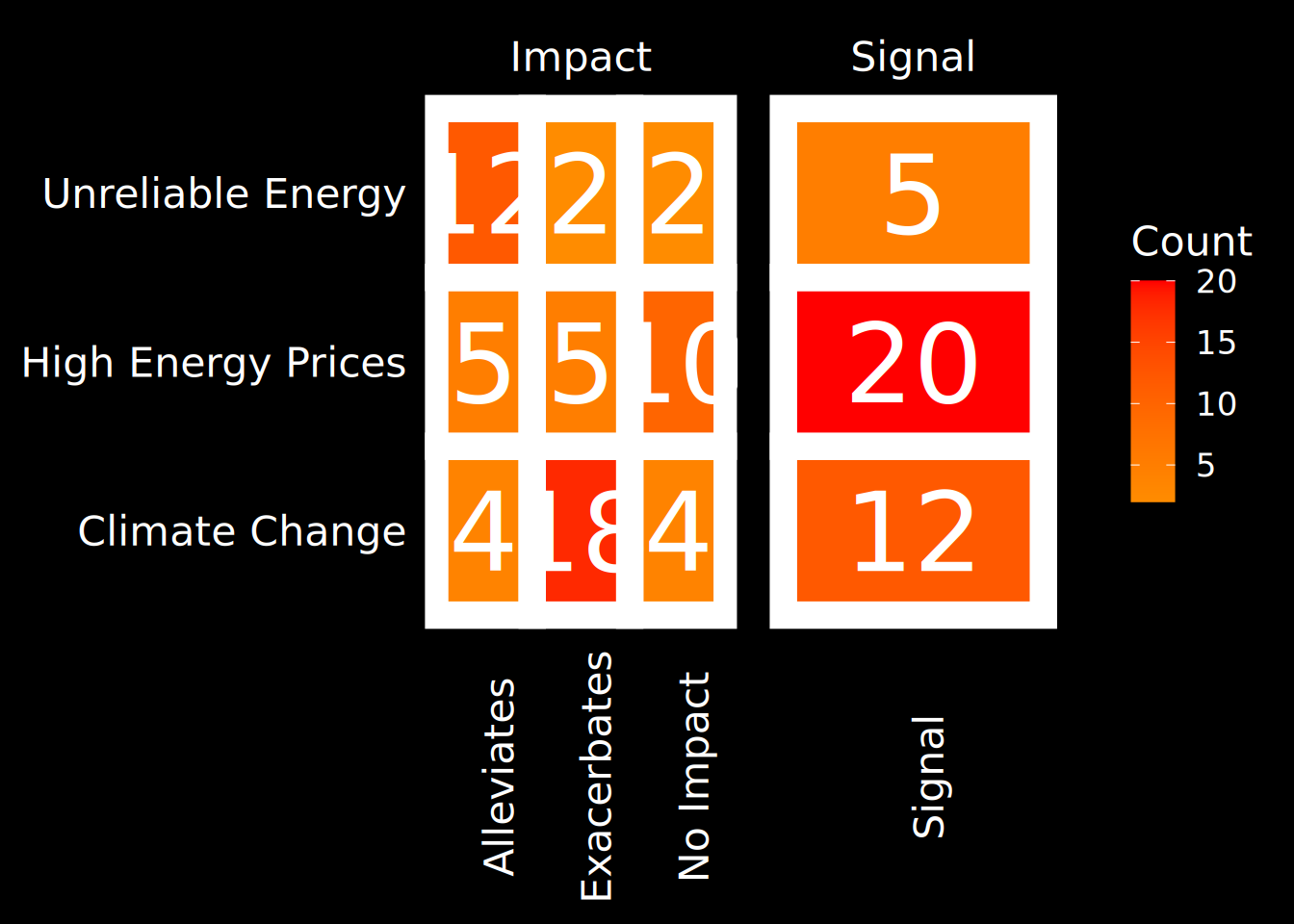
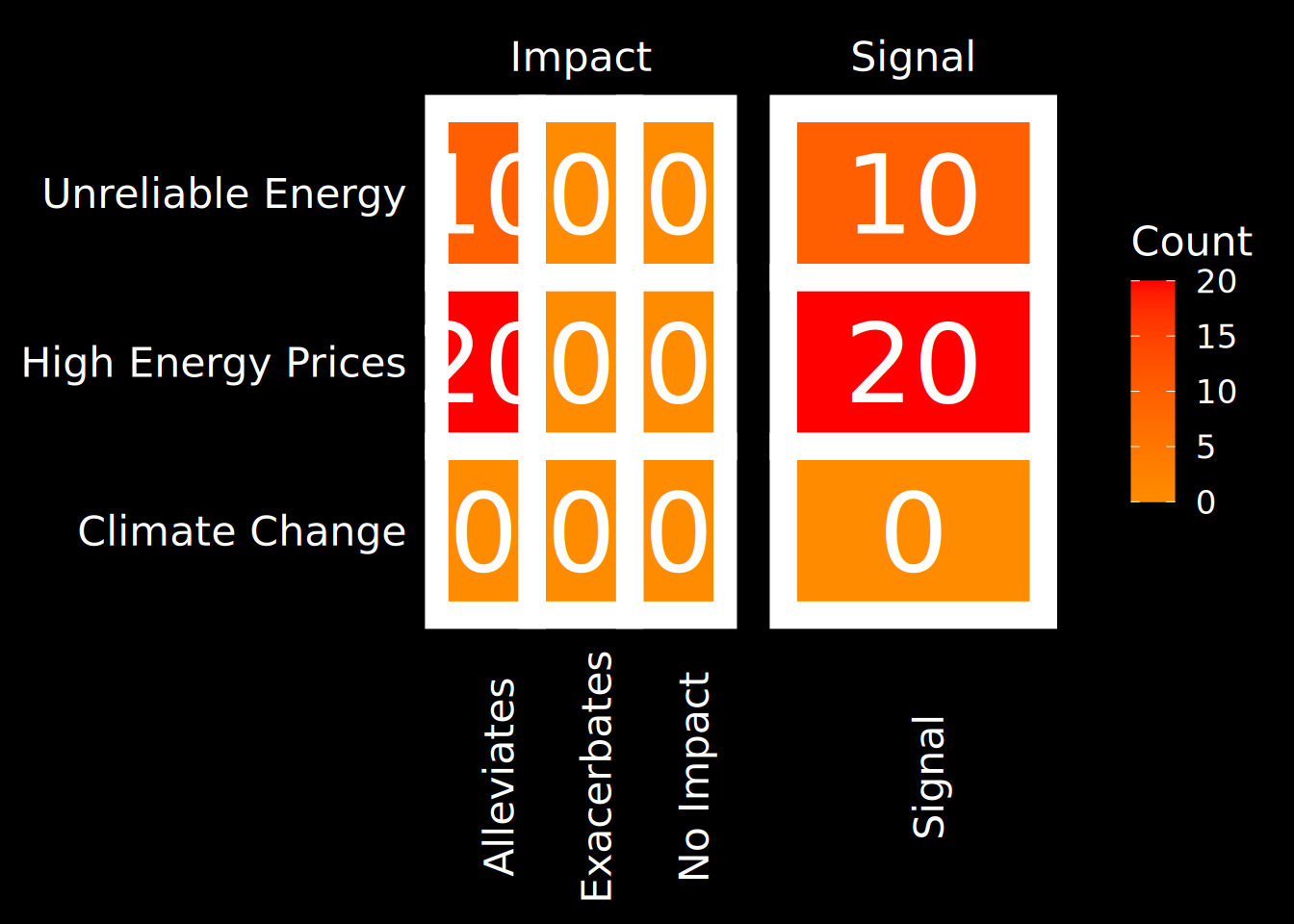
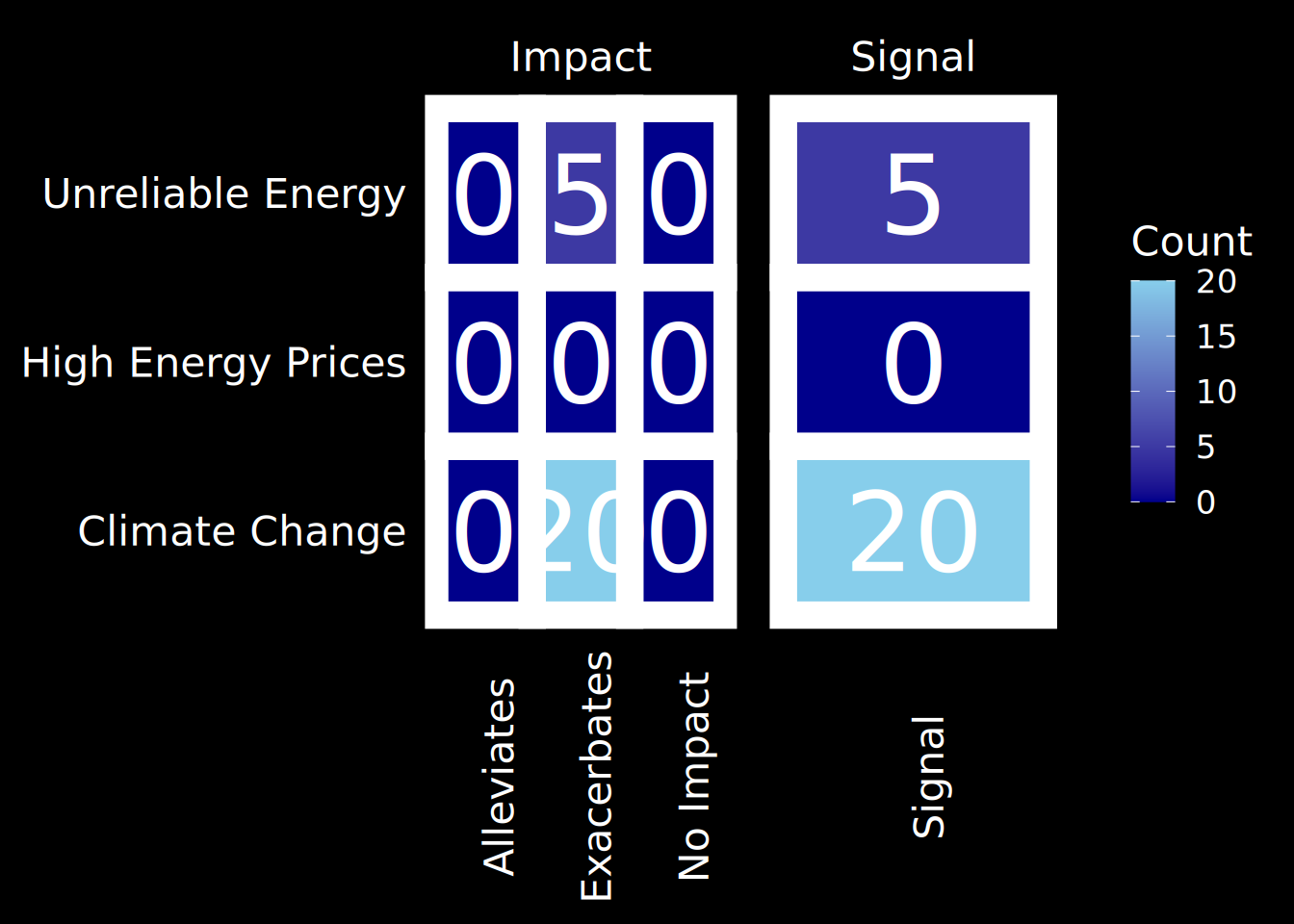
Hypothetical Claim Space Distribution for Infrastructure == Gas, n=20

CLAIM SPACE DISTRIBUTION X CONSTRUCTIVE DISCOURSE

Strong discourse requires a shared worldview and acknowledgement of out-party issues.

When these do not exist, policy discourse nonconstructive and policy does not get implemented

COMPARING DISTRIBUTIONS

  • Neither group acknowledges the other’s key issue
  • Disagreement on whether gas exacerbates or alleviates unreliable energy

FUTURE ANALYSIS

  • Intra- and inter-party distribution comparisons
  • Comparisons to claim spaces outside of parliament
  • Look at questions of constructiveness, representation, and evidence-based
    policy-making in energy policy discourse

SUMMARY