PROGRESS REVIEW

A CLAIM SPACE APPROACH TO POLICY FRAMING AND MISINFORMATION

Alfie Chadwick

2026-10-07

WHY DO WE WANT TO DETECT MISINFORMATION?

THE MODEL

Misinformation exists
→ People believe it
→ It erodes the shared fabric of society
→ Democracy crumbles

If we can detect it, we can build interventions to stop people believing it

THE DEFINITIONAL BOTTLENECK

You cannot detect what you cannot define

  • Bad definitions lead to broken algorithms
  • Too broad: Censors legitimate political debate
  • Too narrow: Misses context, emphasis, and manipulation

FALSE OR MISLEADING INFORMATION

ON INTENTION

We deliberately ignore intent

It is unobservable

Structural impact is identical

FALSE OR MISLEADING INFORMATION

WHAT DOES IT MEAN TO BE FALSE?

  • Rounding Error
  • Minor Misquote
  • Selective Context
  • Statistical Distortion
  • False Attribution
  • Manipulated Media
  • Total Fabrication

Which of these cross the line into “misinformation”?

HOW MUCH IS PROVABLY FALSE?

Explicit falsity is rare

Prevalence depends on definition

WHAT ROLE SHOULD VERACITY PLAY?

Veracity introduces immense computational and theoretical friction

Falsehoods do not automatically mislead, nor do misleading claims require untruths

If truth is elusive and secondary to impact, then it isn’t particularly useful in our definition

FALSE OR MISLEADING INFORMATION

UNITS OF INFORMATION

  • Standard detection pipelines decompose discourse into isolated atomic claims
  • Claims are extracted and evaluated individually against some baseline of misleading claims

CLAIMS CANNOT BE MISLEADING IN ISOLATION

“Wind turbines cause hundreds of bird deaths every year.”

  • As Conservation Policy Input: Evaluating local ecological impact near a native habitat
  • As Anti-Renewable Rhetoric: Framing offshore wind as unacceptable to block development

MISLEADINGNESS IS EMERGENT

  • Decomposing discourse destroys the context that gives claims political meaning
  • Misleading representations can rely on emphasis and omission just as much as lies

FALSE OR MISLEADING INFORMATION ?

BEYOND INFORMATION UNITS

  • Claims are merely the raw materials of communications
  • Individual facts do not carry meaning in isolation
  • Meaning is created by how claims are selected, organized, and emphasized

ENTER FRAMES

  • Frames are the organising principles that structure discourse.
  • They select and connect specific facts to define problems, assign blame, and justify solutions.
  • A frame dictates how every individual claim within it is interpreted.

FALSE OR MISLEADING INFORMATION FRAMES

MISLEADINGNESS REQUIRES A BASELINE

  • Labeling a frame as “misleading” requires comparing it against an authoritative baseline truth.
  • Something is only misleading in relation to what is presumed to be consensus reality.
  • Misleadingness is not an inherent property of the text itself, but a measure of deviation from that baseline.

THE EPISTEMIC CRISIS

  • Establishing a baseline truth assumes universal trust in shared knowledge institutions.
  • In a polarized landscape with parallel and conflicting epistemic institutions, no single baseline is universally accepted.
  • Enforcing one baseline automatically alienates half the audience and turns detection into political arbitration.

FALSE OR MISLEADING ? INFORMATION FRAMES

DO WE NEED CONSENSUS?

  • Rationalist models assume we must reconcile conflicting intuitions into a single baseline.
  • Democratic politics does not require consensus or epistemic harmony.
  • Pluralism works because deeply opposing worldviews are able to coexist within a shared space.

FROM ERROR TO INCOMPATIBILITY

  • We do not need frames to agree, nor do we need to force them into alignment.
  • A frame becomes problematic when it denies the possibility of coexistence.
  • Incompatible frames undermine the shared arena, making pluralistic contestation impossible.

FALSE OR MISLEADING INCOMPATIBLE INFORMATION FRAMES

INCOMPATIBLE FRAMES

Frames that, upon comparison, cannot interact without one or both altering their foundational premises – forcing political debate away from what should be done and onto what is true.

  • Distance does not equal incompatibility
  • Similarity does not guarantee compatibility

WHAT?

WHY ENERGY POLICY?

  • Epistemic battlefield: Fuses technical data, economic models, and climate science into a single debate.
  • Proliferation of frames: Competing narratives rarely clash directly – they prioritise entirely different metrics.
  • High-stakes impasse: Policy stalls not from a lack of options, but from debate stuck on what is real rather than what to do.

WHERE

WHY PARLIAMENT?

  • Forced shared space: One of the few institutional arenas where competing frames must occupy the exact same space.

  • High-density record: Decades of verbatim, structured debate recorded in Hansard.

HANSARD

  • Official verbatim transcript of everything said in parliament.
  • Really difficult to use for longitudinal research

CHAPTER 1: HANSARD DB

  • THE GAP: Hansard hard to use at scale because its huge, unstructured format and inconsistent metadata make systematic analysis difficult.
  • WHAT WE DID: We built a structured pipeline that turns raw Hansard transcripts into a clean, searchable database with standardised speaker identities, extracted debate topics, and organised multi-decade text streams.

Status: Submitted to Computational Communications Research, under review

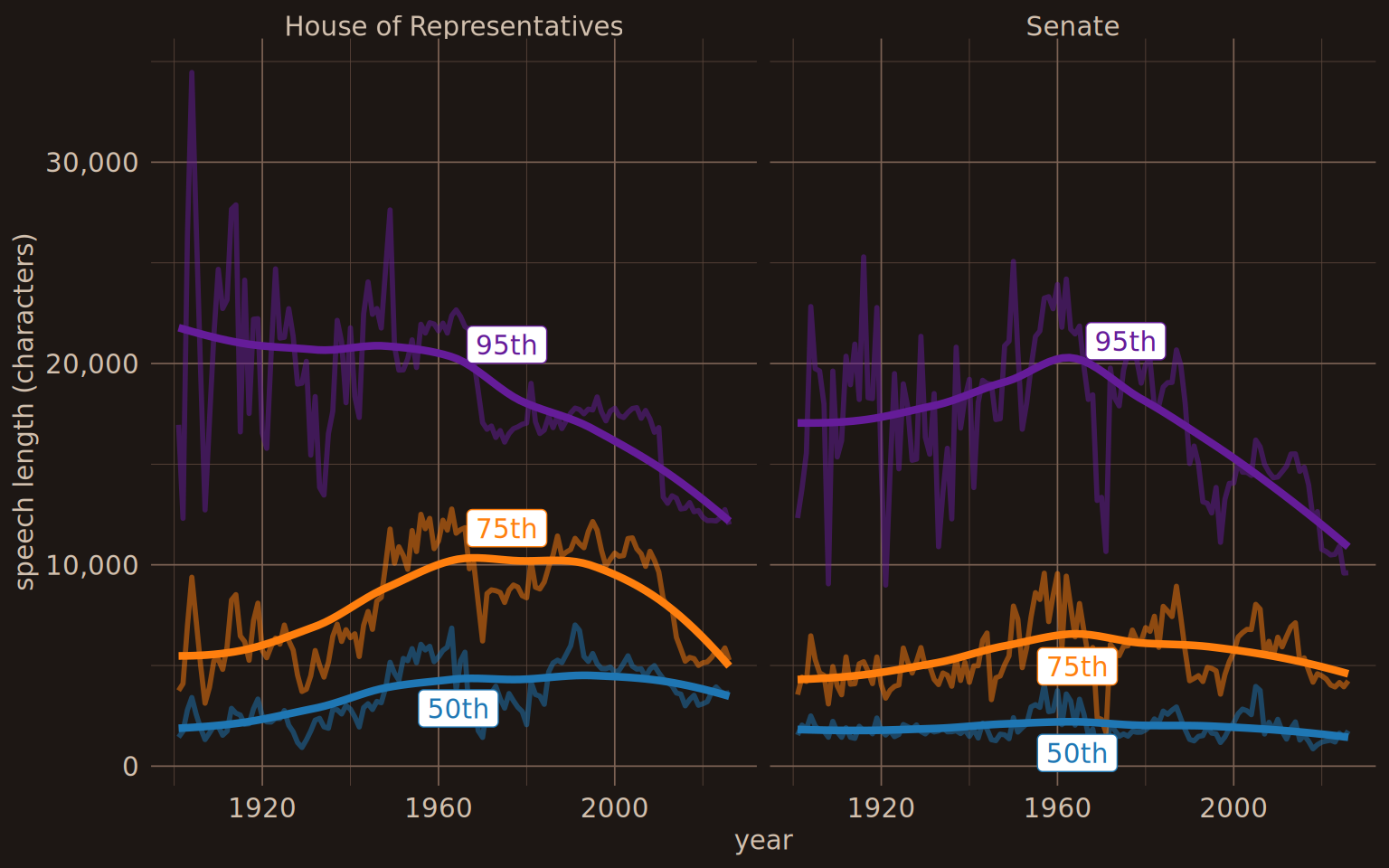
ARE SPEECHES GETTING LONGER?

SELECT
EXTRACT(YEAR FROM sd.date)::INTEGER AS year,
    sd.house,
    PERCENTILE_CONT(0.50) WITHIN GROUP (
        ORDER BY LENGTH(d.text)
        )::INTEGER AS p50,
    PERCENTILE_CONT(0.75) WITHIN GROUP (
        ORDER BY LENGTH(d.text)
        )::INTEGER AS p75,
    PERCENTILE_CONT(0.95) WITHIN GROUP (
        ORDER BY LENGTH(d.text)
        )::INTEGER AS p95,
        COUNT(*)::INTEGER AS n_speeches
FROM "Document" d
JOIN "SittingDay" sd
    ON sd.id = d."sittingDayId"
WHERE d.type = 'speech'
  AND d.text IS NOT NULL
  AND d.text <> ''
GROUP BY year, sd.house
ORDER BY year, sd.house

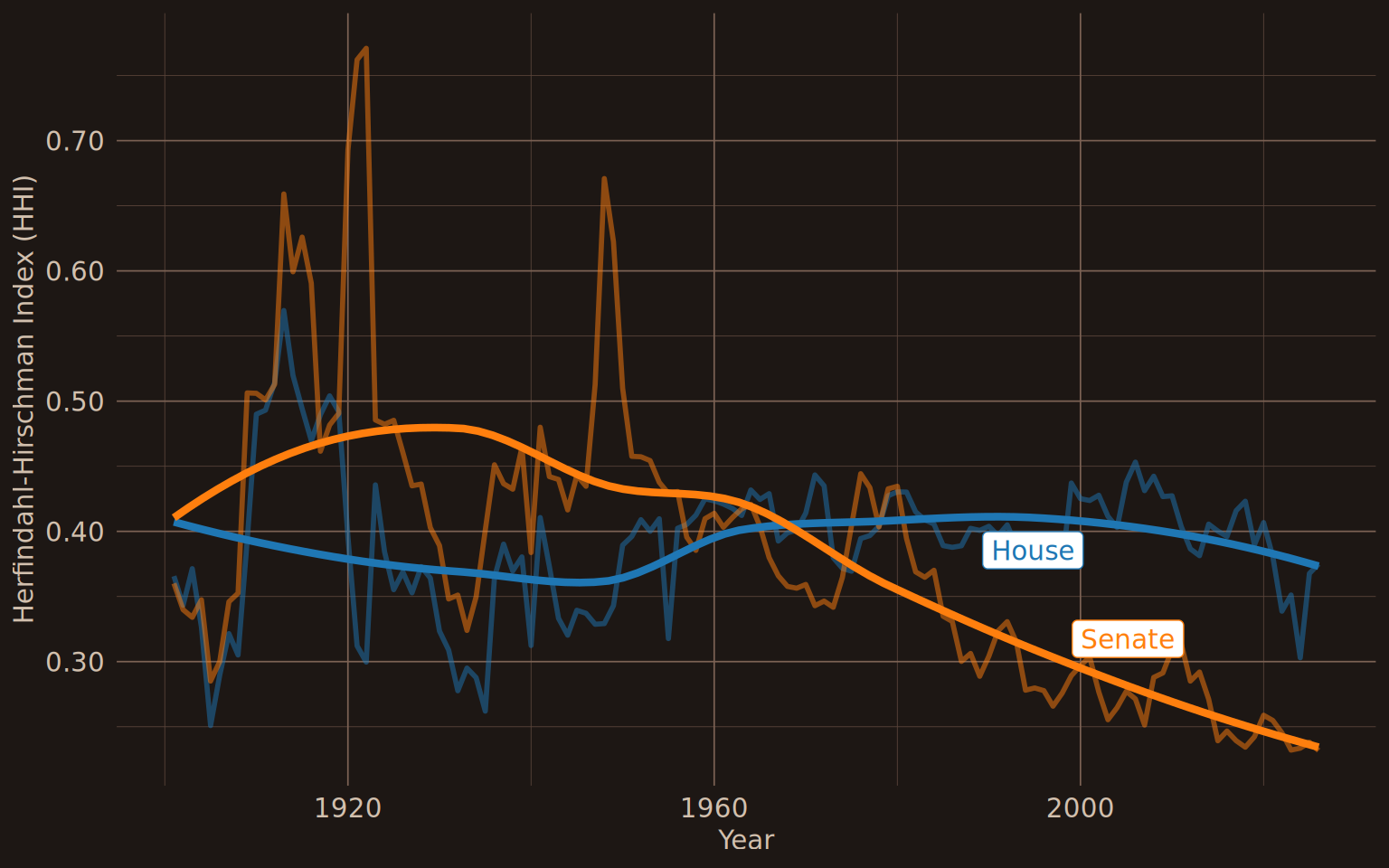
IS SPEECH MORE OR LESS CONCENTRATED?

WITH party_time AS (
    SELECT 
        EXTRACT(YEAR FROM sd.date)::int AS year,
        sd.house,
        py.name AS party,
        SUM(LENGTH(d.text)) AS total_chars
    FROM "Document" d
    JOIN "SittingDay" sd ON sd.id = d."sittingDayId"
    JOIN "rawAuthor" ra ON ra.id = d."rawAuthorId"
    JOIN "Parliamentarian" p ON p.id = ra."parliamentarianId"
    JOIN "Service" sv 
        ON sv."parliamentarianId" = p.id
       AND sd.date >= sv."startDate"
       AND (sd.date <= sv."endDate" OR sv."endDate" IS NULL)
    JOIN "Party" py ON py.id = sv."partyId"
    WHERE d.type = 'speech'
      AND d.text IS NOT NULL
      AND d.text <> ''
    GROUP BY 1, 2, 3
),
shares AS (
    SELECT 
        year,
        house,
        total_chars::float 
        / SUM(total_chars) OVER (PARTITION BY year, house) AS share
    FROM party_time
)

SELECT 
    year,
    house,
    SUM(share^2) AS hhi
FROM shares
GROUP BY year, house
ORDER BY year, house
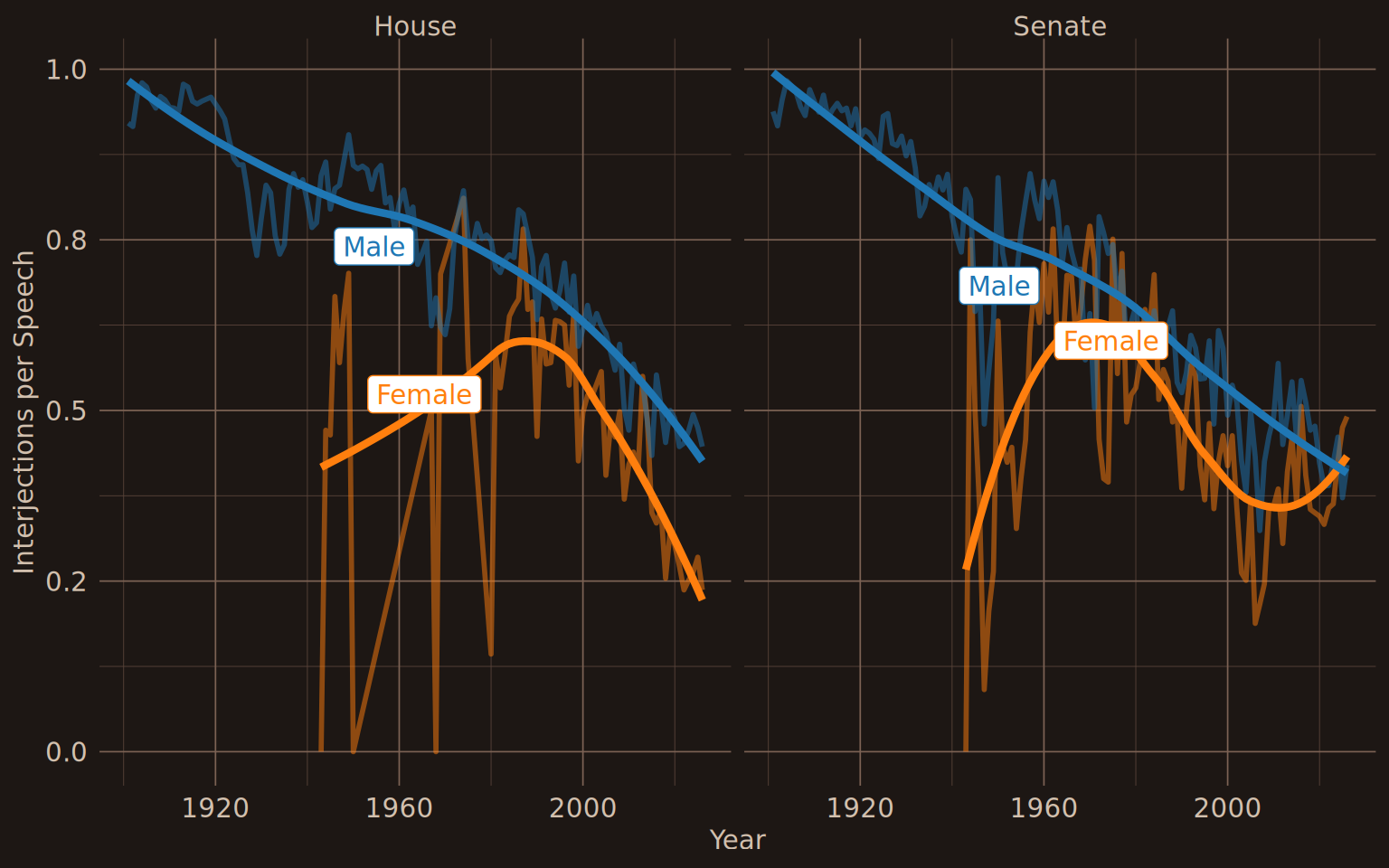
ARE INTERJECTION RATES IMPACTED BY GENDER?

SELECT 
    EXTRACT(YEAR FROM sd.date)::int AS year,
    sd.house,
    p.gender AS gender,

    COUNT(*) AS n_speeches,
    COUNT(i.*) AS n_interjections,

    ROUND(
        (COUNT(i.*)::float 
        / NULLIF(COUNT(*), 0)
        )::numeric,
        3
    ) AS interjections_per_speech

FROM "SittingDay" sd
JOIN "Document" d ON d."sittingDayId" = sd.id
LEFT JOIN "Interjection" i ON i."documentId" = d.id
JOIN "rawAuthor" ra on ra.id = d."rawAuthorId"
JOIN "Parliamentarian" p on p.id = ra."parliamentarianId"
WHERE d."type" = 'speech'
    AND sd."chamber" = 'Primary Chamber'


GROUP BY 1, 2, 3
ORDER BY 1, 2, 3
A WARNING TO USERS

While Hansard is a great tool, it is also prone to misinterpretations. The record is shaped by:

  • Institutional Rules
  • Party Politics
  • Editorial Discretion
  • Textual Nature

WHAT TO USE TO ANALYSE THIS DATASET?

  • Topic Modeling: Aggregates word clusters to show what is discussed
  • Predefined Frames: Forces text into rigid, static typologies (e.g., economic vs. environmental)
  • Emerging LLM Methods: Generate rich narrative summaries and claim extractions, but lack a formal, standardised space to quantify comparison.

CHAPTER 2: CLAIM SPACE ANALYSIS

  • THE GAP: Current computational methods for capturing frames treat them as discrete categories, which doesn’t capture the organisational nature of the frames.
  • WHAT WE ARE DOING: Building a new statistical representation of frames that allows for their comparison. We are building these representations using large language models.

Status: Mostly written, looking to submit to Communications Methods and Measures EOY 2026

“To frame is to select some aspects of a perceived reality and make them more salient in a communicating text, in such a way as to promote a particular problem definition, causal interpretation, moral evaluation, and/or treatment recommendation for the item described.”

Robert Entman (1993)

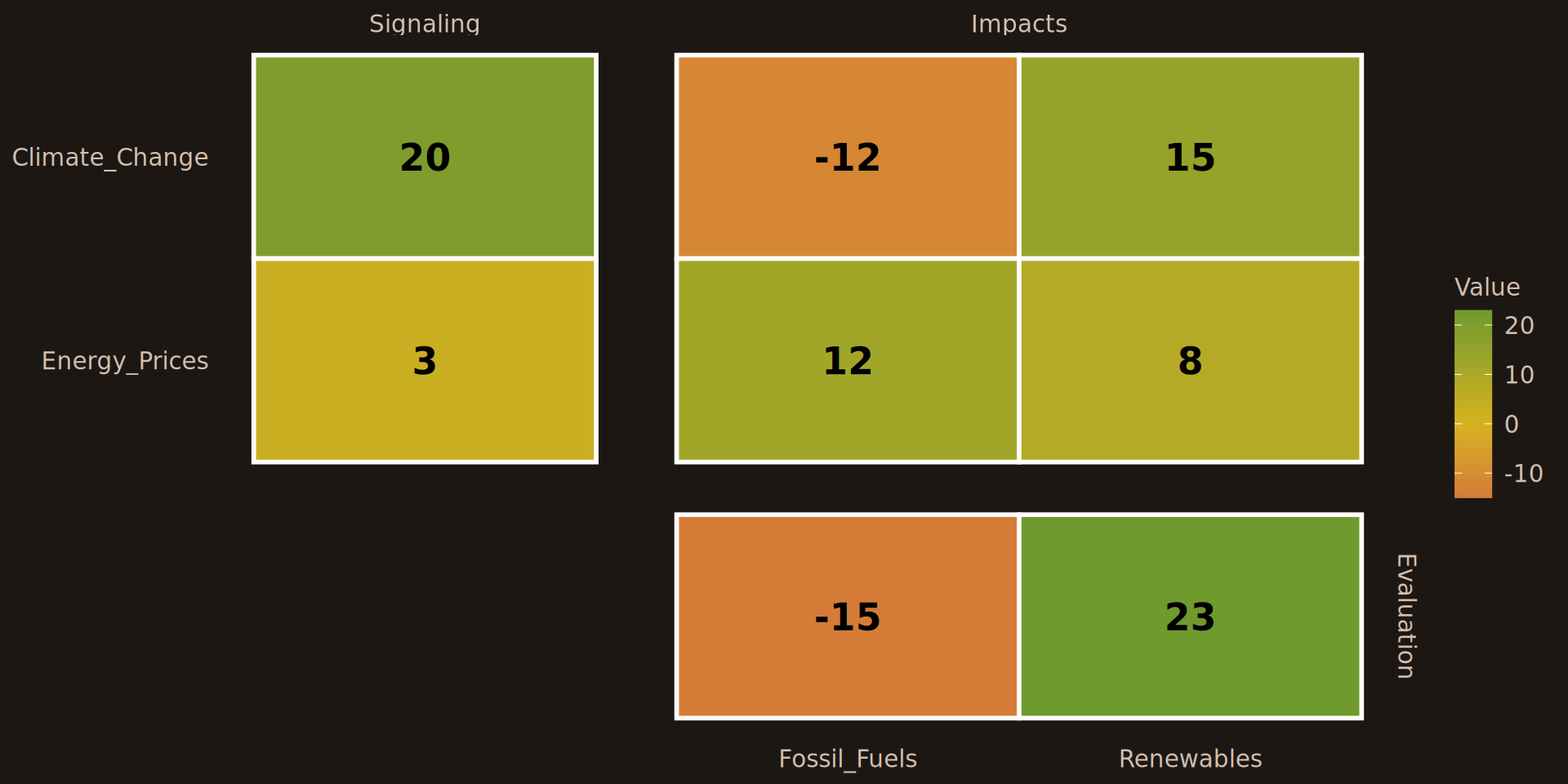
CLAIMS

Issue-Signalling Claims: “We care about X”

Impact Claims: “Policy Y impacts issue X in this way”

Evaluation Claims: “We should use policy Y”

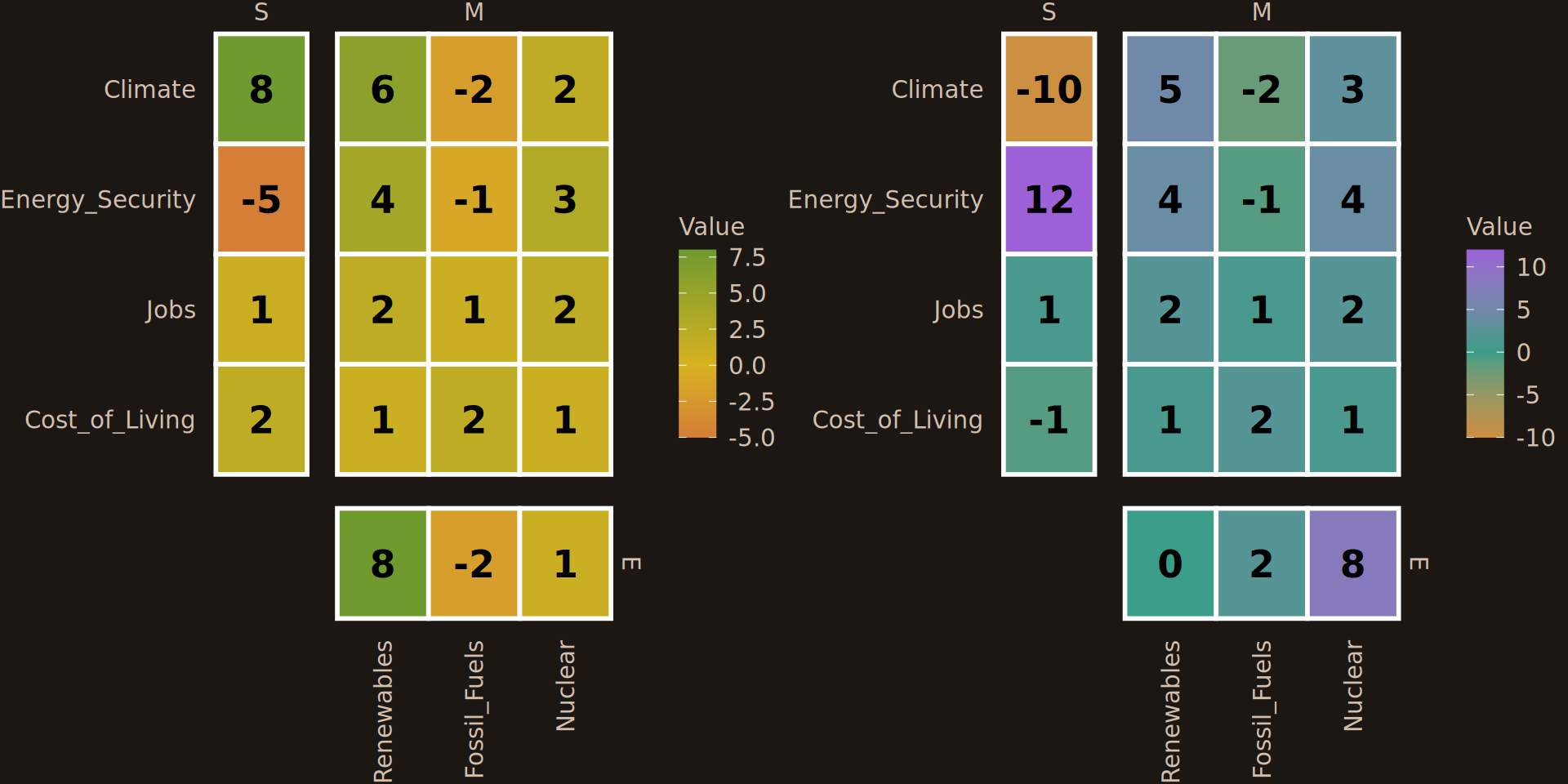
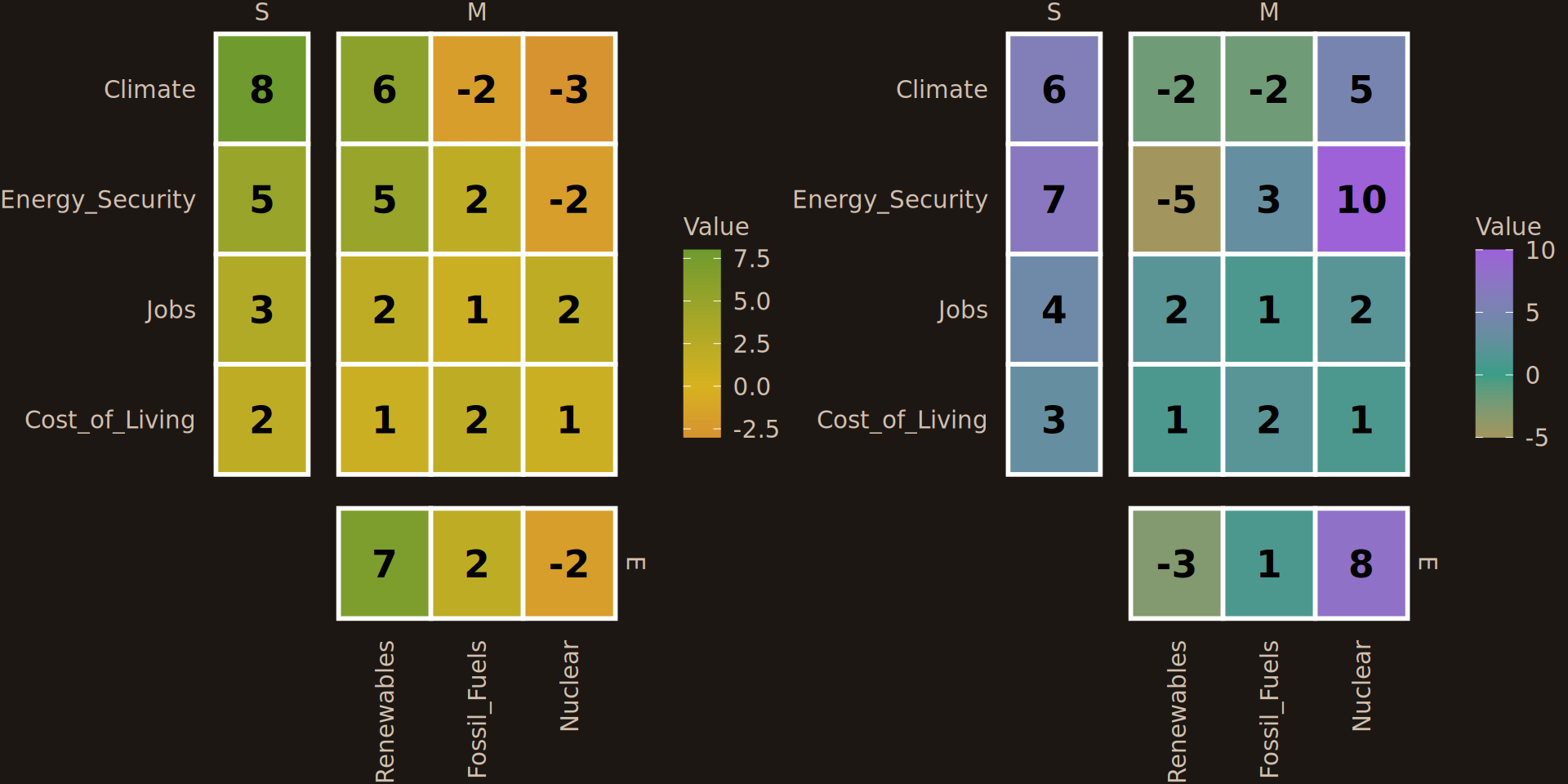
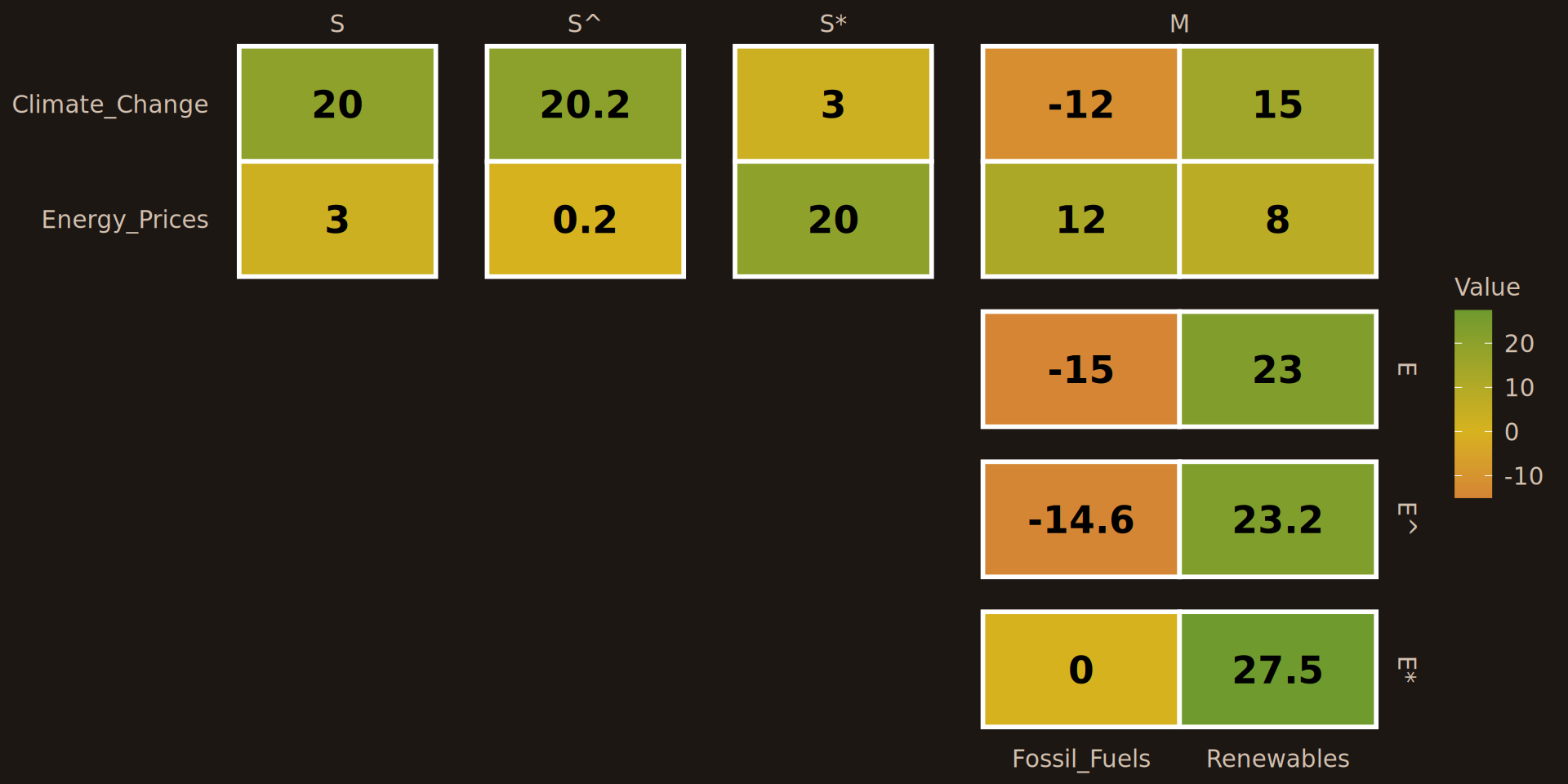
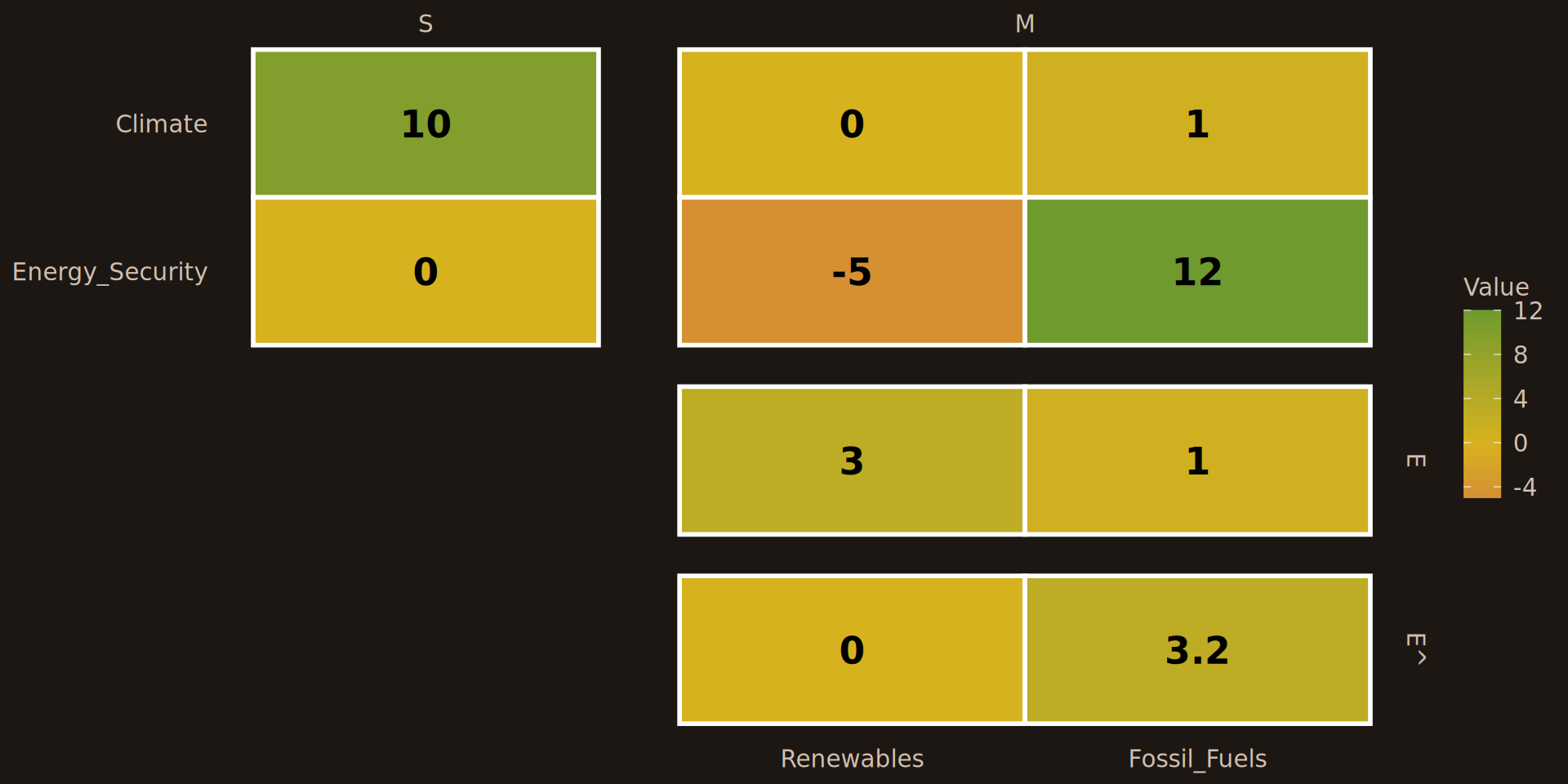
CLAIM SPACE

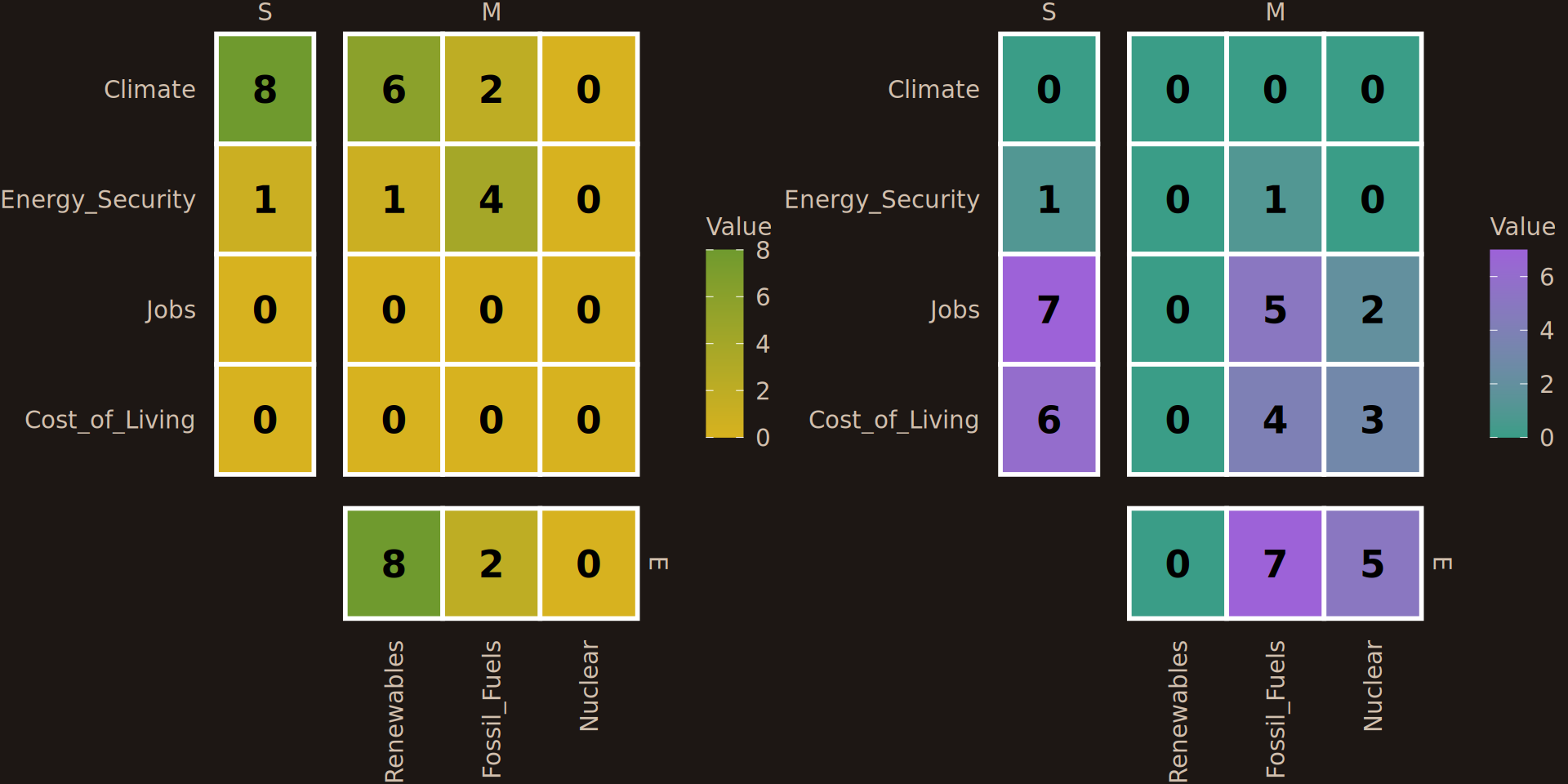
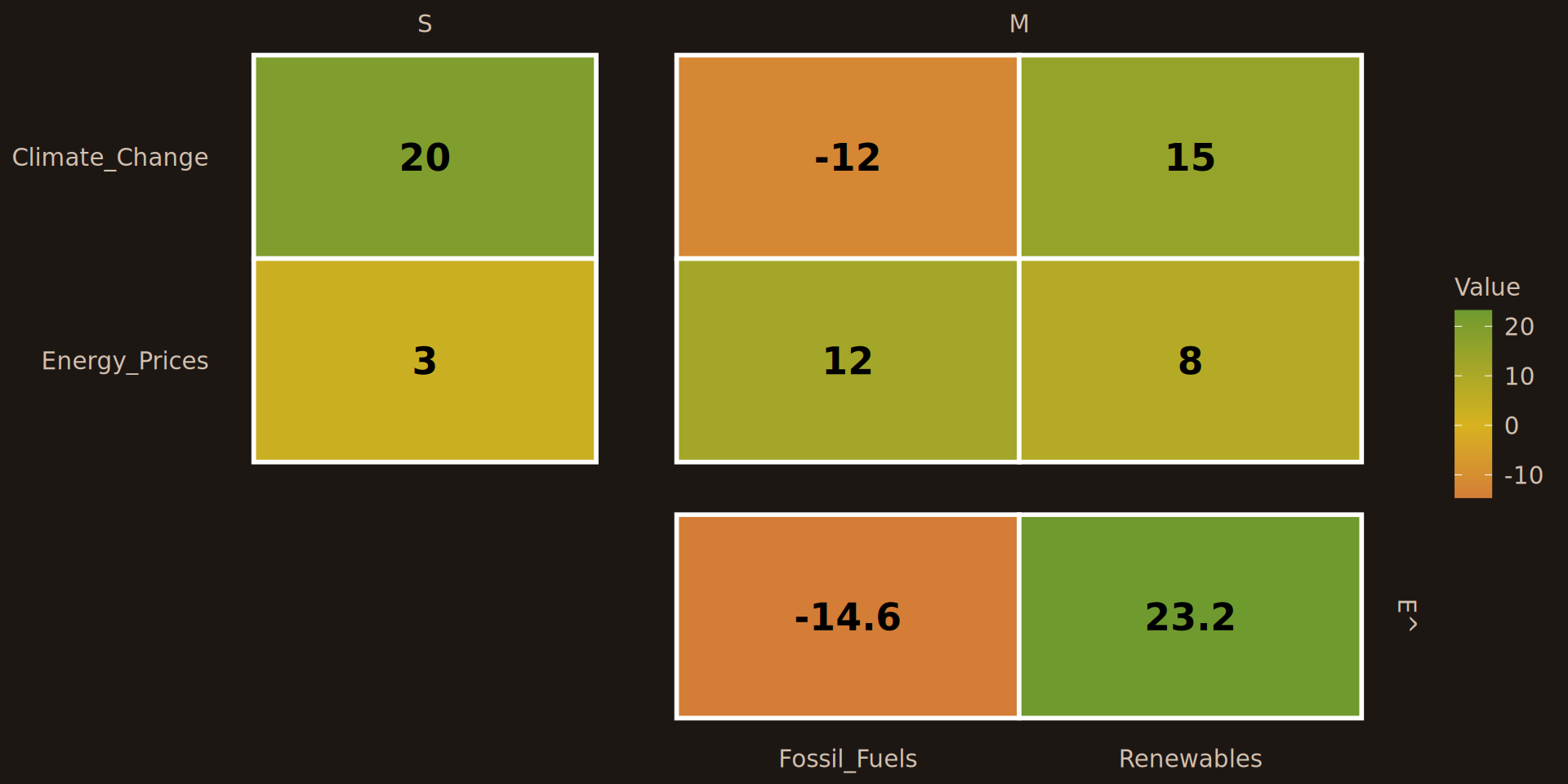
IMPLIED VALUES

\[ \hat{E}_u = \frac{M_u S_u}{\|M_u S_u\|}\,\|E_u\| \qquad \hat{S}_u = \frac{M_u^{-1} E_u}{\|M_u^{-1} E_u\|}\,\|S_u\| \]
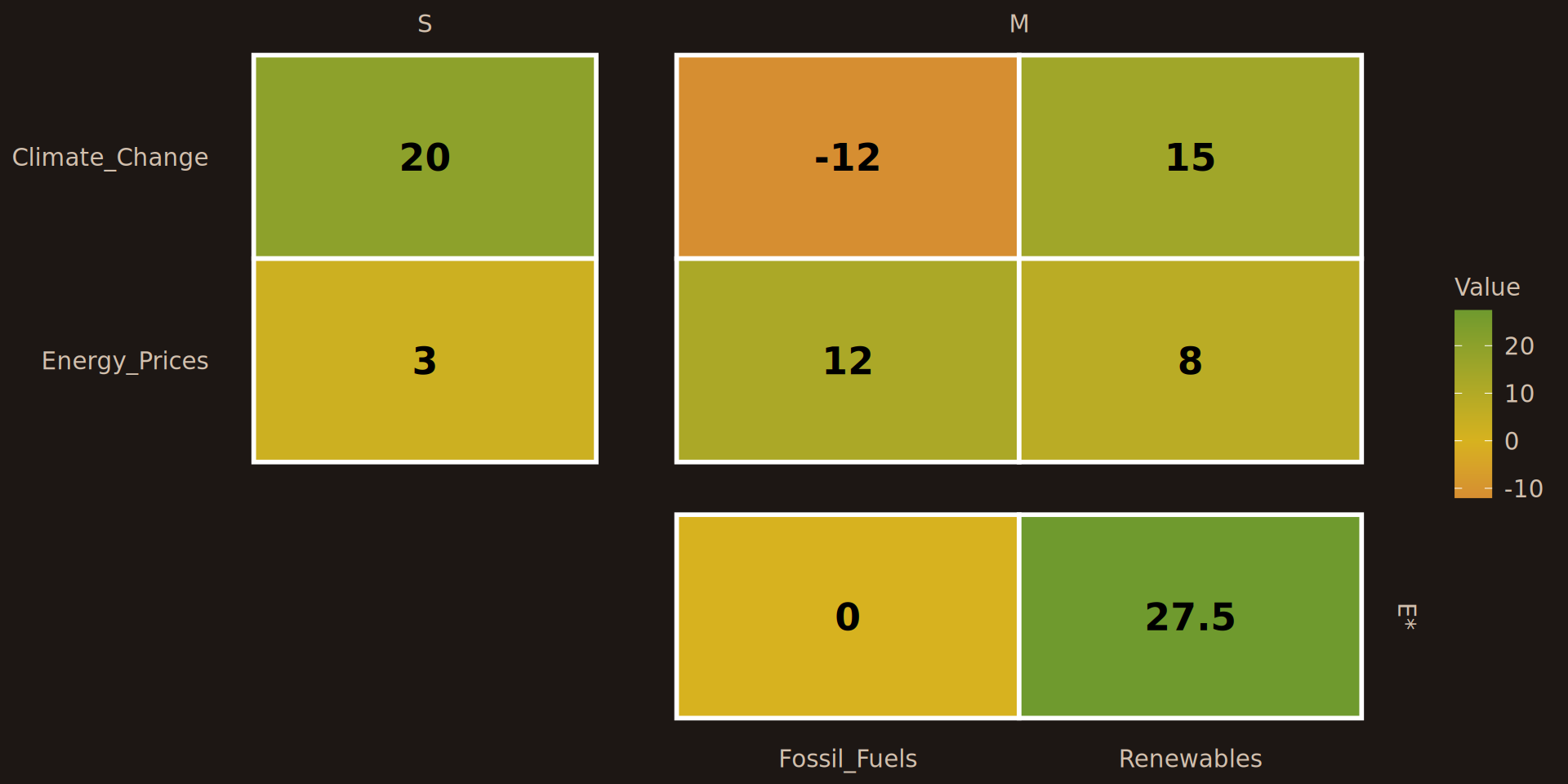
EQUALISED VALUES

\[ {E}_u^\ast = \frac{M_u\mathbf{1}_{|I|}} {\left\|M_u\mathbf{1}_{|I|}\right\|} \left\|\hat{E}_u\right\|, \qquad {S}_u^\ast = \frac{M_u^\top\mathbf{1}_{|P|}} {\left\|M_u^\top\mathbf{1}_{|P|}\right\|} \left\|\hat{S}_u\right\|. \]
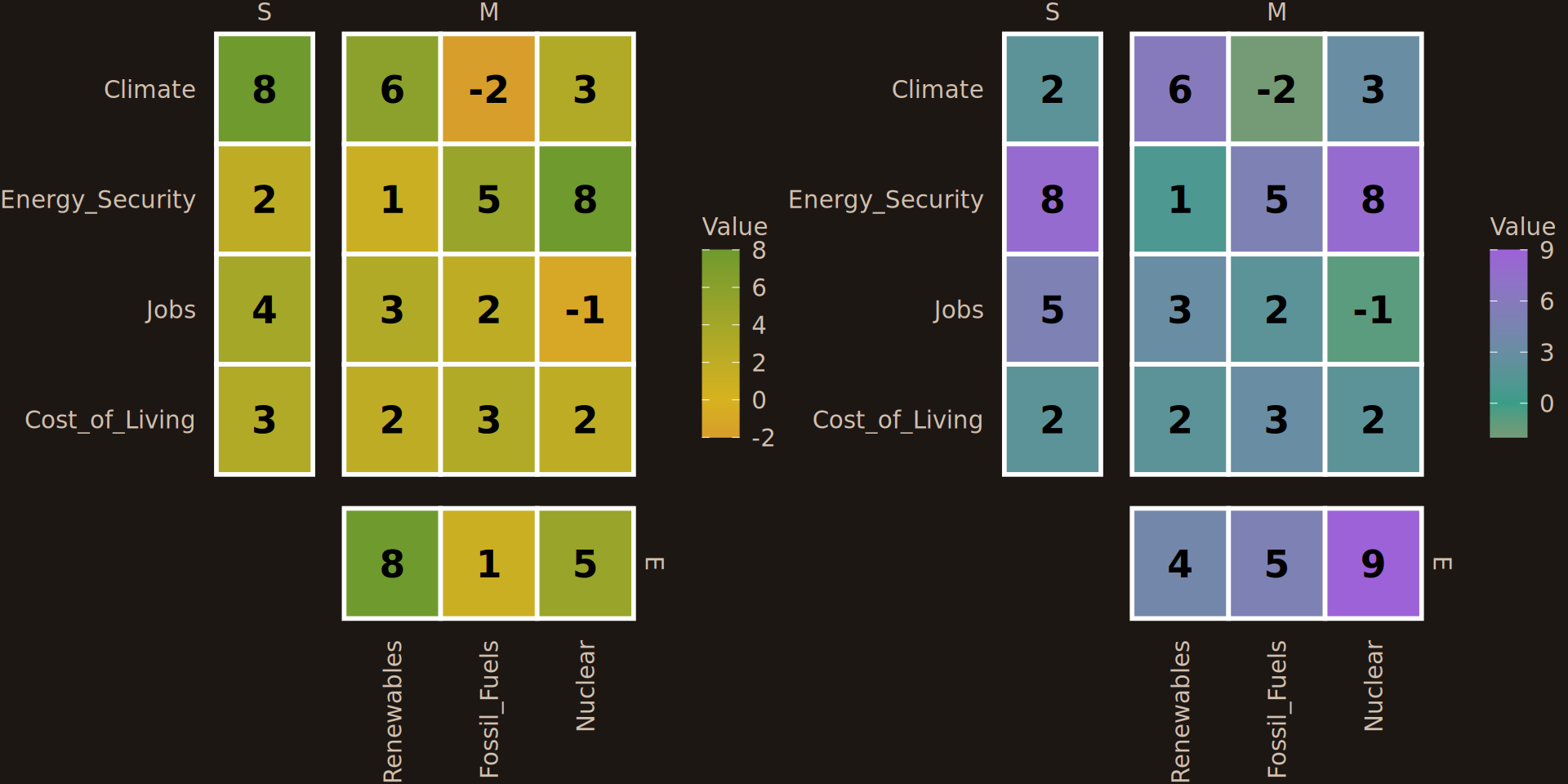
FULL CLAIM SPACE
THE COHERENCE HYPOTHESIS

If a reasonable decomposition of the items comprising \(u\) substantially reduces the distance between \(E\) and \(\hat{E}\),his suggests that \(u\) may conflate multiple frames, with the resulting components providing a more coherent representation of those distinct frames.

WHY SHOULD THIS HOLD?

It is difficult to sustain an incoherent frame.

If the items captured as a single frame do not form a coherent interpretation, they may not constitute a single frame at all.

[1] "Frame Similarity: 0.316227766016838"
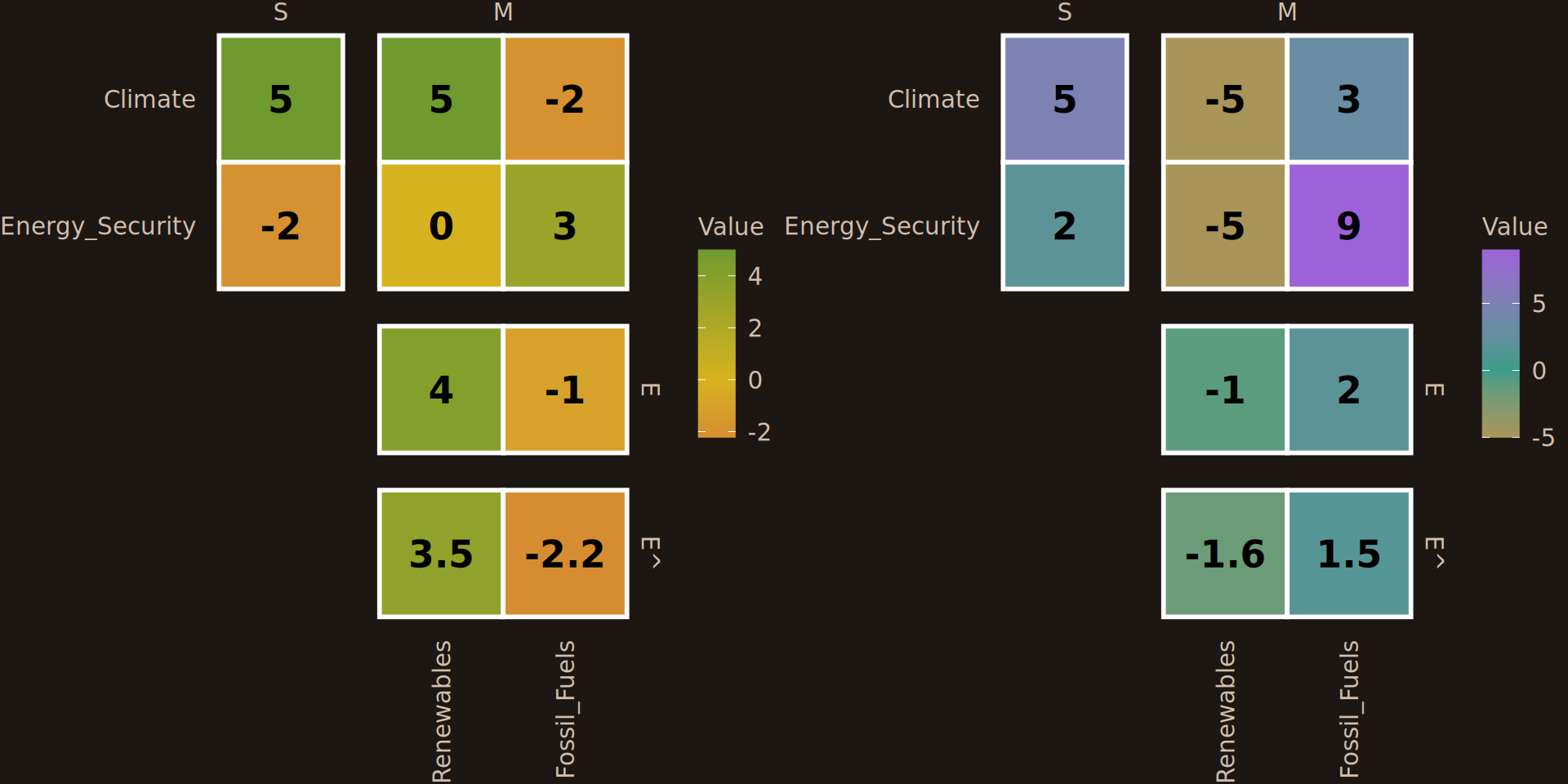
[1] "Frame 1 Similarity: 0.947863007628856"
[1] "Frame 2 Similarity: 0.938976437519108"

CHAPTER 3: DESCRIBING PARLIAMENTARY FRAMES IN TERMS OF INCOMPATIBILITY

  • THE GAP: While people have looked at the frames in parliamentary energy policy, little has been done to quantify their compatibility
  • WHAT ARE WE GOING TO DO: Create metrics for quantifying features of compatibility, and see how they change over the history of Parliament regarding energy policy

Status: Planned out, waiting on chapter 2 to be finalised

Engagement

Are the two actors talking about the same policies or issues?

\[ K_V = \frac{ V_A^{\mathrm{gross}}\cdot V_B^{\mathrm{gross}} }{ \|V_A^{\mathrm{gross}}\|\, \|V_B^{\mathrm{gross}}\| }, \qquad V\in\{S,E\} \]

1 → complete overlap
0 → no overlap

LOW ENGAGEMENT

HIGH ENGAGEMENT

Issue Compatibility

Do they make opposing claims about the same issues?

\[ K_{\mathrm{issue}} = 1 - \frac{ S_A^+\!\cdot S_B^- + S_A^-\!\cdot S_B^+ }{ \sqrt{ \|S_A^+\|^2+\|S_A^-\|^2 } \sqrt{ \|S_B^+\|^2+\|S_B^-\|^2 } } \]

1 → no opposing overlap
0 → complete opposing overlap

LOW ISSUE COMPATIBILITY

HIGH ISSUE COMPATIBILITY
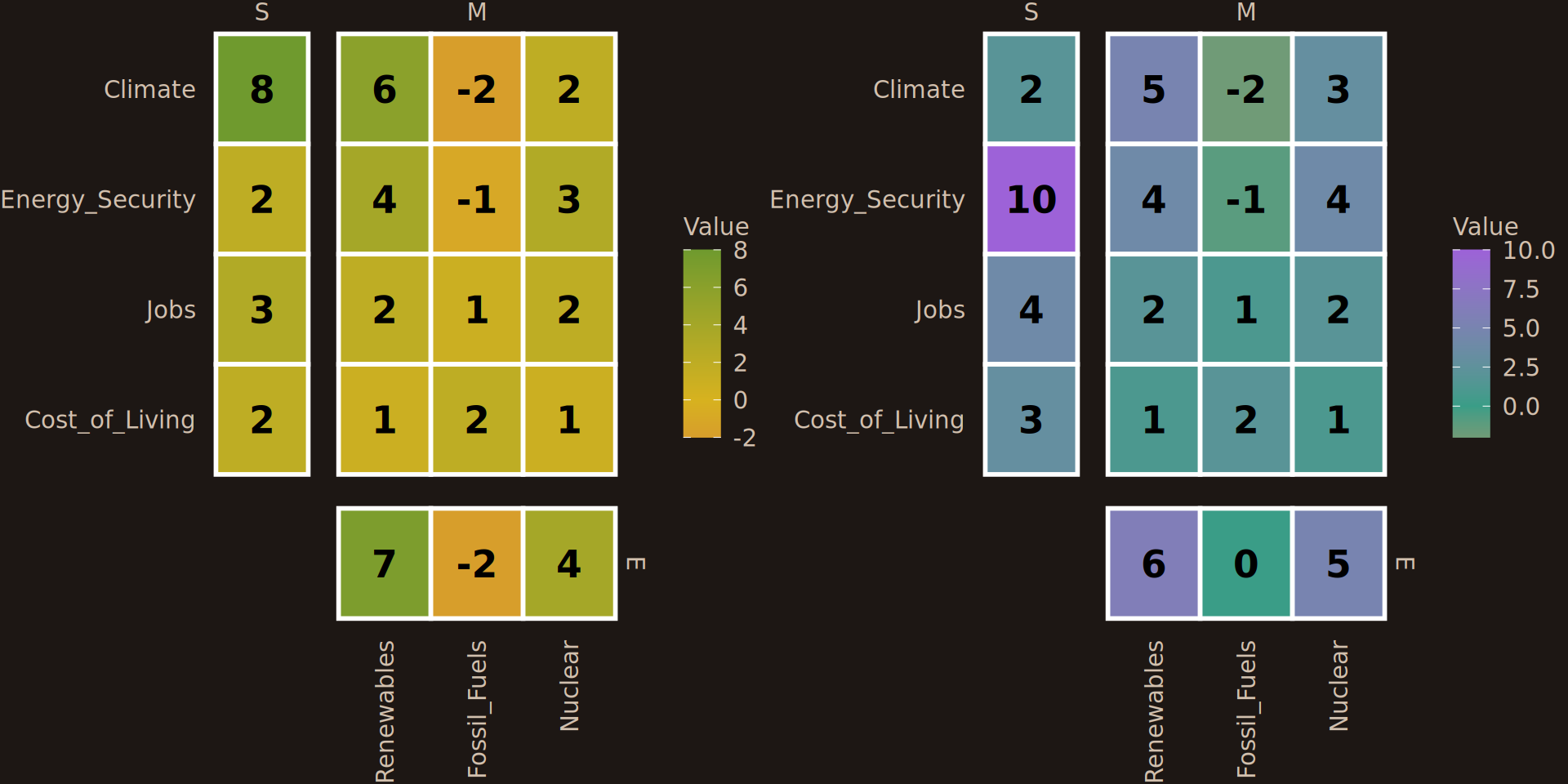
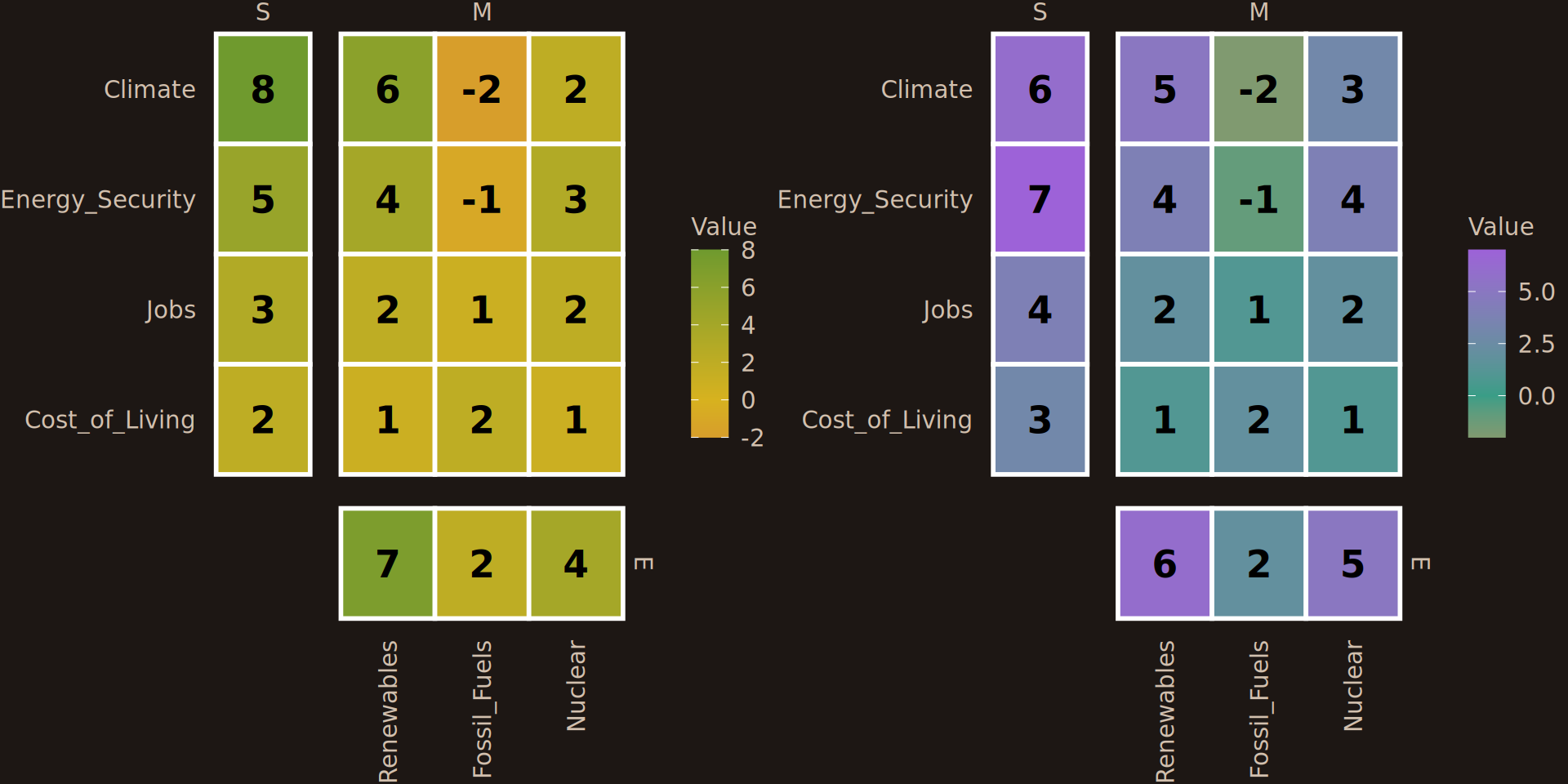
Epistemic Compatibility

Do they make opposing claims about the same policy impacts?

\[ \small K_{\mathrm{epistemic}} = 1 - \frac{ \langle M_A^+,M_B^-\rangle_F + \langle M_A^-,M_B^+\rangle_F }{ \sqrt{ \|M_A^+\|_F^2+\|M_A^-\|_F^2 } \sqrt{ \|M_B^+\|_F^2+\|M_B^-\|_F^2 } } \]

1 → no opposing overlap
0 → complete opposing overlap

LOW EPISTEMIC COMPATIBILITY

HIGH EPISTEMIC COMPATIBILITY
CHAPTER 4: SHOCKS

  • THE GAP: Methods for detecting misinformation at scale struggle specifically during shocks, when we need them most.

  • WHAT ARE WE GOING TO DO: Apply CSA and our compatibility metrics during short-term shocks

Status: Planned out, waiting on chapter 2 to be finalised

THE SHOCKS

  1. Queensland Floods - 2011
  2. South Australian Blackout - 2016
  3. Black Summer Bushfires - 2020
  4. Russian Invasion of Ukraine - 2022
  5. European Gas Crisis - 2022
  6. National Electricity Market Suspension - 2022
  7. Outbreak of the Israel–Hamas War - 2023
  8. Closure of the Strait of Hormuz - 2026

THE MECHANISM

Immediate activation & disruption

  • issue salience \(S^{\mathrm{gross}}[i]\) increases
  • Established frame fit is disrupted → coherence decreases

Longitudinal realignment

  • Evaluation realignment: \(E^{\mathrm{net}} \rightarrow E^{\mathrm{net}\prime}\)
  • Causal realignment: \(M^{\mathrm{net}} \rightarrow M^{\mathrm{net}\prime}\)
  • Salience regression: \(S^{\mathrm{net}} \rightarrow S^{\mathrm{net}\prime}\)

WHAT I’M NOT DOING